

The Real Reason Transition Is Hard
Everyone told me to update my resume. Nobody told me I was grieving.
When I got out of the Army after more than two decades, everyone had advice for me. Update your resume. Translate your military experience into civilian language. Practice your elevator pitch. Network. Apply. Repeat.
I did all of it. And I still felt completely lost.
Not because the advice was wrong, but because it was solving the wrong problem. What I was dealing with was not a skills gap. It was a grief I did not have a name for — and no resume workshop in the world was going to touch it.
What the Research Shows
The military does not just provide employment. It provides structure, community, purpose, rank, culture, and a sense of belonging so complete that leaving it can feel less like changing careers and more like leaving a country. The people who worked alongside you and shared the same sacrifices — gone. The daily sense of mission — gone. The rank that told the room who you were before you said a word — gone.
A 2025 systematic review of 19 qualitative studies found that, for many veterans, leaving service brought a profound sense of identity loss, and that some male and female veterans expressed a sense of bereavement at losing their military identity while struggling to build a new one [1].
That is not a resume problem. That is grief. And the transition system was not designed to address it.
The Extra Weight Women Veterans Carry
For women veterans, this loss carries an additional layer that most transition programs never acknowledge.
In civilian life, a woman veteran is frequently not recognized as a veteran at all. In a study of 33 Canadian women veterans, Dr. Maya Eichler found that women are expected to fit the male norm during service but are rarely recognized as veterans after it [2]. She is asked to prove her service. She is assumed to be a spouse or dependent. She is navigating a civilian culture with a very specific — and very male — image of what a veteran looks like.
On top of that, she is often expected to navigate civilian norms of femininity that the military largely suspended. The same research found that women veterans encounter challenges fitting into dominant norms of femininity after service, and the 2025 review found that adaptations women made in the military often clashed with civilian expectations of women [1], [2].
This is not a small adjustment. It is a fundamental dislocation of self. And it does not show up on any resume.
What Actually Helps
The research points to several things that genuinely ease the transition — and none of them are resume tips.
Community. In a grounded theory study of 20 women veterans, Burkhart and Hogan found that participants maintained their identity in civilian life by re-establishing connections with the military, friends from the military, and veteran groups [3]. Other women who share the experience are not just comfort. They are confirmation.
Structure. Research published in 2025 found that when people transitioning into a new job perceived greater structure in their organization, they reported greater confidence in their work and a stronger sense of belonging [4]. Clear expectations provide some of the scaffolding the military always supplied.
Naming the grief. Many women veterans have been told — by well-meaning civilians, by the system, and by their own internalized military stoicism — that they should be grateful to be out and should simply move on. In my experience, the women who move through transition most effectively are the ones who allow themselves to grieve the military world while building something new.
What I Know Now
You cannot navigate a transition you refuse to fully acknowledge. The real work of transition is not updating your LinkedIn profile. It is rebuilding your sense of self — your identity, your purpose, your understanding of who you are when the structure, the rank, and the mission no longer define you.
That work is hard. It takes longer than a few days of transition classes. And it deserves more support than most veterans ever receive.
That is exactly why I built Beyond the Uniform — because I lived this, and I know what it takes to move through it.
References
- Smith, A., Rafferty, L., Croak, B., Greenberg, N., Khan, R., Langston, V., Sharp, M.-L., Stagg, A., Fear, N., & Stevelink, S. (2025). A systematic review of military-to-civilian transition: The role of gender. PLOS ONE, 20(2), e0316448. https://doi.org/10.1371/journal.pone.0316448
- Eichler, M. (2022). Making military and Veteran women (in)visible: The continuity of gendered experiences in military-to-civilian transition. Journal of Military, Veteran and Family Health. https://doi.org/10.3138/jmvfh-2021-0077
- Burkhart, L., & Hogan, N. (2015). Being a female veteran: A grounded theory of coping with transitions. Social Work in Mental Health, 13(2), 108–127. https://doi.org/10.1080/15332985.2013.870102
- Gibbs, W. C., Ortosky, L., MacLean, A., Kay, A. C., & Sherman, D. K. (2025). Structure in transition: The role of structure in facilitating workplace efficacy and belonging for military veterans and civilians. PLOS ONE, 20(2), e0317575. https://doi.org/10.1371/journal.pone.0317575
Ready to lead beyond the uniform? Every engagement starts with a conversation. Book a discovery call with Renea.
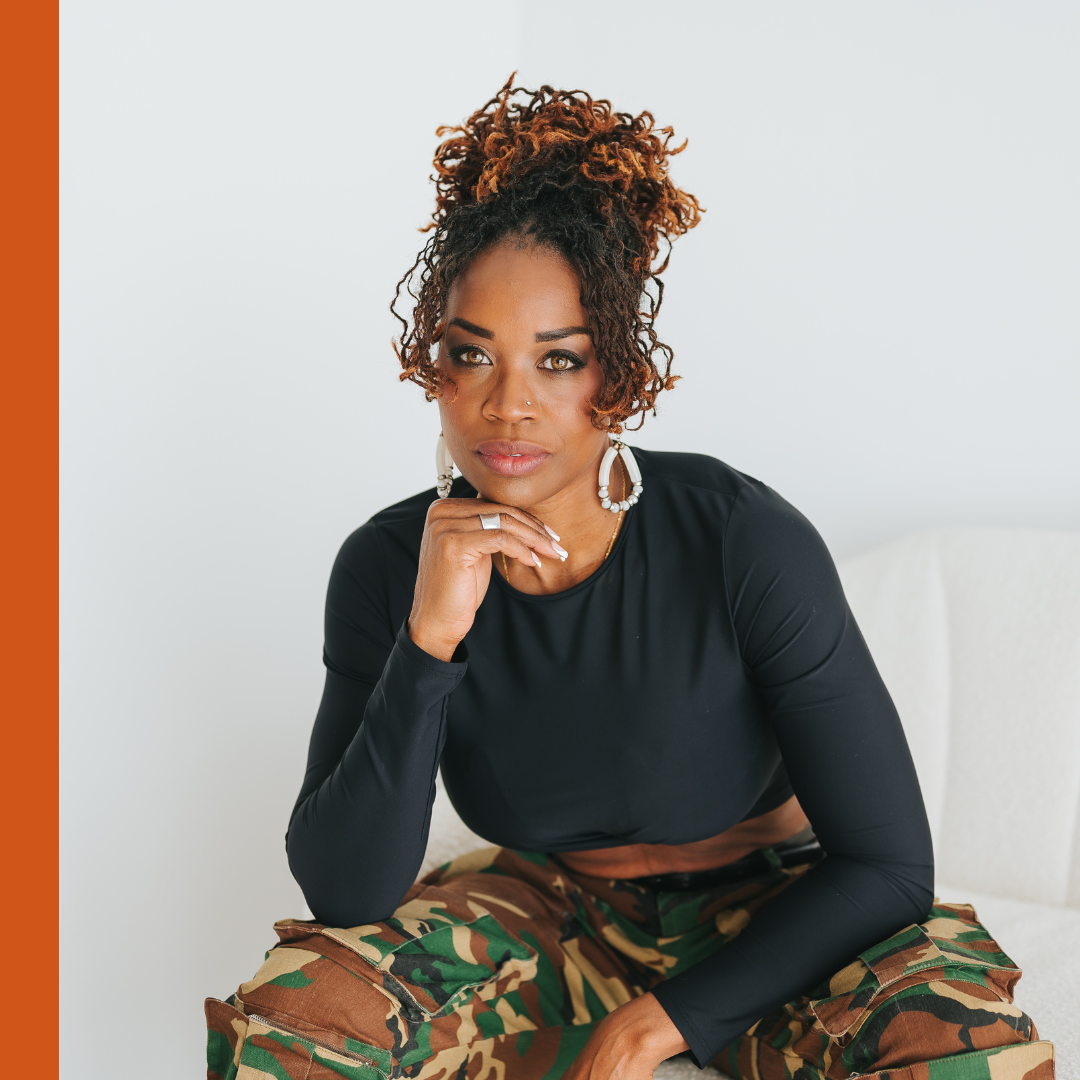
I’m Renea Jones-Hudson
Retired U.S. Army Captain, PsyD candidate, and founder of Beyond the Uniform. I help women veterans own their story and lead with confidence after service through OWNIT group coaching, speaking, and community.

Download your copy of the OWNIT Workbook